
ROTTERDAM, July 6 – One of Europe’s largest solar power rooftop installations has been brought onstream by solar developer Sunrock on PATRIZIA’s 210,000 sqm Maasvlakte logistics development in Rotterdam’s harbour area. The project will deliver a major contribution to the Dutch government’s target of aligning with the EU’s ‘Green Deal’ and making the economy net carbon neutral by 2050, while also accounting for around half of the total solar power output of PATRIZIA’s Dutch logistics real estate portfolio.
Sunrock has installed a 120,000 sqm photovoltaic (PV) system on the roof of the Maasvlakte logistics development with a capacity of 25 Megawatt peak (MWp) a year of clean energy, which is sufficient to meet the annual energy needs of approximately 8,000 households.
The Sunrock and PATRIZIA solar energy partnership has the ambition to double the current 53 megawatt (MW) installed PV capacity across PATRIZIA’s 1.2 million sqm European logistics portfolio, which is now mainly concentrated in the Netherlands, as well as in Germany, France and Belgium. That expansion would bring PATRIZIA’s total solar power capacity to over 100 Megawattpeak (MWp), which is sufficient to power around 37,000 households
Emile Poort, PATRIZIA Country Head for the Netherlands, said: “When PATRIZIA acquired the Maasvlakte distribution centre development in 2021 for EUR 230 million, it was the biggest single Dutch logistics real estate deal by area on record. Now in our partnership with Sunrock, we have set a new sustainability benchmark with the largest single rooftop solar power installation in the Netherlands, and this is just the start of PATRIZIA’s pan-European renewable energy journey in the logistics sector. The wide rooftop areas and typically large site footprints of ‘big box’ logistics developments are ideal for the installation of PV systems. Our ambitious plans are just the tip of the iceberg, as the fast-expanding European logistics real estate industry rolls out its vast network of renewable energy production hubs, which will make a major contribution to the EU’s carbon-neutral targets and in the existential battle against climate change.”
Rooftop PV systems have a key role to play in the energy transition, particularly in densely populated countries such as the Netherlands where development space is at a premium, and therefore, public and political support is higher.
A research study from the ENSPRESO Joint Research Centre of the European Commission concluded that there is the potential to install 570 Gigawatt peak (GWp) on the rooftops of large logistic real estate properties across Europe, which is estimated to be enough capacity to power 150 million households in Europe. Total net electricity generation in the EU in 2021 was 2,785 Terrawatthours (TWh), of which 32.8% was produced from renewable sources, including wind (13.7%), hydro (13.3%) and solar (5.8%), according to Eurostat.
Johannes Duijzer, CEO of Sunrock, said: “We are rapidly expanding into Europe developing rooftop solar PV projects with our real estate partners. We bring the expertise from the Dutch market and gain traction in Germany, France, Belgium and the UK. Our partnership with PATRIZIA is instrumental in expanding our international reach across European markets. Solar power is the cheapest and most reliable form of energy which drives the transition to a clean energy future. Our rooftop solar PV projects are non-controversial and add to the quality of the underlying real estate. Furthermore it offers tenants better service and helps PATRIZIA reach their impact goals.“
PATRIZIA: A leading partner for global real assets
With operations around the world, PATRIZIA has been offering investment opportunities in real estate and infrastructure assets for institutional, semi-professional and private investors for 39 years. PATRIZIA manages more than EUR 58 billion in assets and employs over 1,000 professionals at 28 locations worldwide. PATRIZIA is making an impact since 1984 by helping children in need, since 1992 in close collaboration with Bunter Kreis (“colourful circle”) in Germany for aftercare of children with severe diseases and since 1999 through its support for the PATRIZIA Foundation. The PATRIZIA Foundation has helped around 280,000 children in need worldwide gain access to education and thus, has given them the chance of a better life over the last 24 years. You can find further information at www.patrizia.ag
About Sunrock
Sunrock is unstoppable. We are working with European companies, organisations and governments on a bespoke energy strategy, and we are the number one in large scale solar projects. From solar systems to smart batteries and from asset management to clear dashboards. Sunrock arranges it all; feasibility studies, subsidy applications, financing and insurance. From the operation and management of solar parks to the utilizing of the clean energy generated by them.
In 2012, Sunrock was established in the Netherlands as a start-up in solar energy for logistics real estate. Sunrock has been part of COFRA Holding since 2020 and has grown to more than 120 employees in the Netherlands, Belgium, Germany and France. Sunrock has realised 500 MWP of solar energy and an additional 2GWp in development. With an outspoken commitment to our ESG criteria we are on a clear mission: powering forward with our clients, towards a a clean energy future.
Contact:
Bellier Communications
Jakob Geerts
Jakob.geerts@bellierfinancial.com
Sunrock
Communications and PR
Janneke Rijpkema
j.rijpkema@sunrock.com
Sunrock joined a number of sustainability conscious companies by signing the Diversity Charter on November 14 2022. In doing so they became one of 414 businesses to sign the Charter in the Netherlands. Sunrock is a leading player in the rooftop solar sector and truly believes it is part of a clean energy future. Pursuing diversity and inclusion is directly in line with our corporate value to do good. We are convinced by the importance of diversity and inclusion in achieving our purpose. By signing the Charter, Sunrock publicly commits to promoting the application of the principles of equal opportunity across the company, and has adopted KPIs to measure its diversity and the perception of inclusion experienced by Sunrockers. Elisabeth Stevens, Chief Operations Officer of Sunrock, signed the charter on behalf of the company.
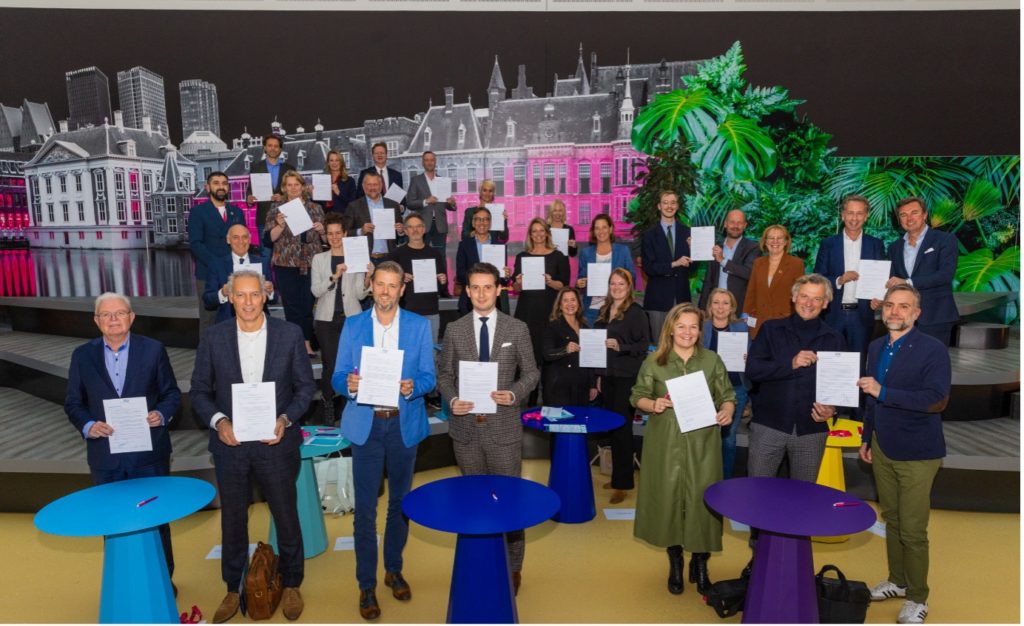
In the summer of 2022, Sunrock conducted its first company wide diversity, equity and inclusion survey. 82% of employees responded to the survey, giving the company a representative view of its diversity profile and the extent to which employees consider the company to be an inclusive environment. The outcome of the survey fed into the KPIs that Sunrock has set for measuring and improving its diversity and inclusion performance in 5 dimensions: age, sexual orientation, ethnic/cultural diversity, gender and workability.
According to research, less than 22% of workers in the energy sector are female. The numbers are even more dire when one looks at the percentage of women in technical roles within the energy sector. We aspire to break this pattern and to increase the representation of female employees across all departments in the company. Sunrock strives to have gender parity by the end of 2028 or at least a 40% female staff population. Additionally, it has the ambition to reach 25% ethnic/cultural diversity within the same period.
“Meeting the high ambitions of the energy transition requires a dedicated and talented workforce that is inclusive and reflects the diversity of society around us. Through the Diversity Charter, Sunrock commits to investing in a more diverse and inclusive working environment that allows each individual to flourish in their uniqueness, whilst benefiting from the strength of the collective.” Elisabeth Stevens, Chief Operations Officer
Speakers at the signing ceremony in The Hague included Karien van Gennip who is the Minster of Social Affairs and Employment in the Netherlands, Jacco Vonhof of the Royal Association of MKB (representing small and medium enterprises) and Søren Abildgaard (CEO of T-mobile, and the host of the event). Sunrock’s ESG Manager, Manuella Appiah joined the Minister and other speakers in a panel, sharing Sunrock’s approach to incorporating diversity and inclusion considerations within recruitment at a time of extreme labor shortage.
Following the signing of the Diversity Charter, Sunrock is expected to submit an action plan containing it’s approach to realizing its commitments. Annually, the independent secretariat that monitors the extent to which signatories are meeting their Charter commitments, will assess the progress being made by Sunrock and guide the company in realizing their ambitions. The Sunrock ESG working group on People Welfare and the ESG Manager of Sunrock lead the important work on this theme at Sunrock.
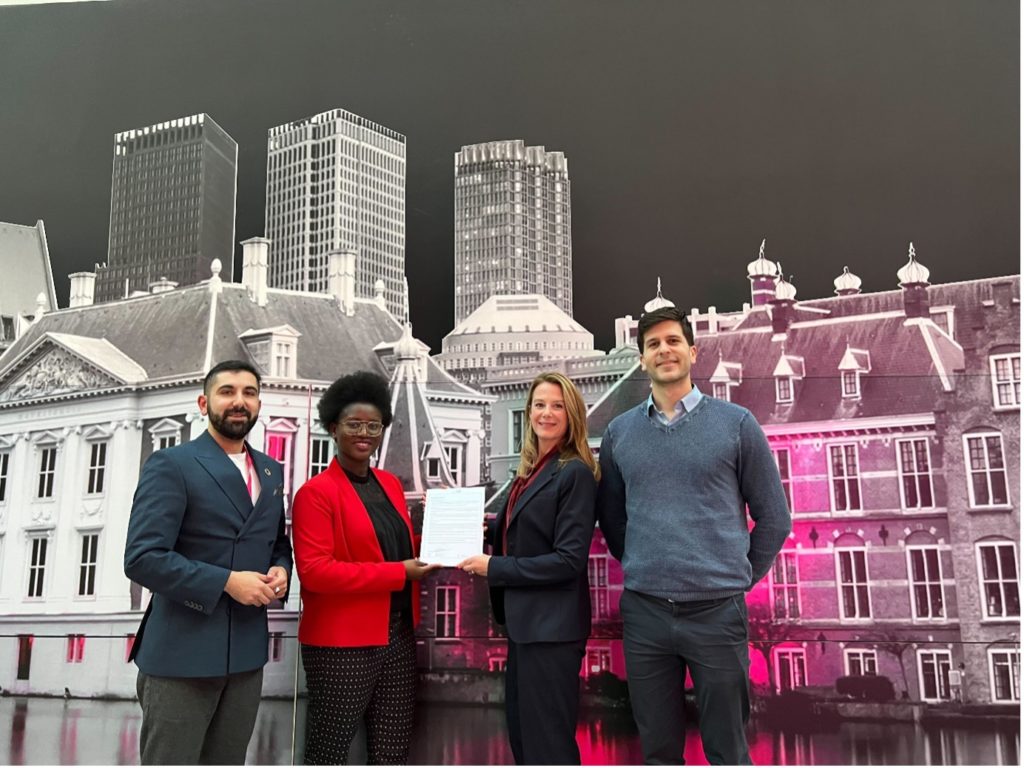
Want to learn more?
For more information about Sunrock’s approach to ESG and our work on diversity and inclusion, please contact:
Manuella Appiah (she/her)
ESG Manager
Sunrock, the market leader in the Netherlands of large-scale solar installations, has assigned the maintenance of a large part of its roof projects to Zonnepark Services Nederland. Thanks to this maintenance contract, Zonnepark Services Nederland breaks through the barrier of one gigawatt of signed Operations & Maintenance (O&M) contracts in the solar energy sector; a unique achievement in the Netherlands.
Zonnepark Services Nederland, a joint venture of Chint Solar and GOLDBECK SOLAR that focuses exclusively on O&M of large-scale solar projects, will perform various maintenance activities for Sunrock, including data monitoring, preventive and corrective maintenance and periodic inspections. The roof projects will be maintained over a period of five years.
With the signing of the O&M contract, Zonnepark Services Nederland reaches a new milestone: it is the first Dutch company in the solar energy sector to be responsible for the maintenance of more than one gigawatt of solar projects. The majority of the current portfolio of Zonnepark Services Nederland still consists of ground-mounted solar projects. With the Sunrock portfolio, rooftop projects will now also be added. As a result, the company takes an important step in further strengthening its market leading position and expanding its existing activities.
Eelco Hoogduin, Managing Director of Zonnepark Services Nederland: “I am extremely pleased that we can work for Sunrock. I’ve been in contact with Sunrock for over eight years in various capacities, right back to when they were still in a small office on the Keizersgracht in Amsterdam. Since then, Sunrock has grown into a leading international player occupy a pivotal role in energy transition within the Netherlands and increasingly in other countries as well. I therefore look forward to a long and successful collaboration with them. The fact that, thanks to this maintenance contract, we have broken through the barrier of 1 gigawatt of signed O&M contracts is the icing on the cake.”
Mark Pruissen, Director Asset Management of Sunrock: “We are very pleased to grant the maintenance of this portfolio of rooftop projects to Zonnepark Services Nederland . The close cooperation between Zonnepark Services and GOLDBECK Solar gives us extra comfort. We work well together with GOLDBECK Solar in the Netherlands and abroad. The Zonnepark Services team has demonstrable their experience and a good reputation in the Dutch market. Their experience in the field of solar energy on large scale roofs also gives us confidence that both the interests of Sunrock and those of the property owners and tenants are in good hands with Zonnepark Services.
Contact
Eelco Hoogduin
info@zonnepark-services.nl
+31 30 781 0000
About Sunrock
In recent years Sunrock has become the market leader in large-scale solar installations in the Netherlands. Sunrock is now expanding these sustainable energy solutions with ground, water and carport projects throughout Europe. Sunrock develops the projects from start to finish, takes care of everything and remains involved during the operational phase. Sunrock now employs more than 100 people, from developers to project managers, data experts and technicians. In 2020 Sunrock has become part of Cofra, the investment company of the C&A family Brenninkmeijer. www.sunrock.com
About Zonnepark Services Nederland
Zonnepark Services Nederland B.V. is a Joint Venture between Chint Solar and GOLDBECK Solar that focuses exclusively on ‘operations and maintenance’ of large-scale solar projects. The company currently has more than 1 gigawatt of solar projects under contract. The Joint Venture offers its customers more than 20 years of global experience in solar energy, combined with the local expertise of the company’s Dutch engineers and maintenance technicians.
www.zonnepark-services.nl
PEOPLE SHOULD BE THEMSELVES
Esther has been treasurer at Diversity Works since the beginning of 2021. This organization is committed to diversity and inclusion within the supply chain and logistics. “People should feel at home in an organization and be able to say what they want, regardless of age, gender or origin. Inclusion and diversity go hand in hand. More diversity leads to more room for inclusion and vice versa. If you create a culture where everyone can be themselves, you get different opinions and you make better decisions.”
The need for sustainable energy is huge. And in the future, 60 times more solar and wind energy will be needed due to the further electrification of transport and industry.
At the same time, there is large unused unused potential in
the form of empty roofs and other unused surfaces suitable for PV (solar
panels).
This offers opportunities for property owners and entrepreneurs, say
Jildar van der Galiën and Tonnie van Grinsven. Sunrock makes the link.
The solar energy market is developing at a rapid pace and Sunrock is making a significant contribution to this. This service provider develops, builds, finances, operates and monitors solar parks, both on the roof, on the ground and on the water. ’We help companies achieve their sustainable ambitions and reduce dependence on fossil fuels’, says Jildar van der Galien. “The first step is to develop a high-quality solar panel park for the customer, but afterwards we can also provide storage solutions, charging infrastructure and advice on smart energy consumption.’ This approach is very successful. Since the start in 2012 this innovative company has grown to become the market leader in large-scale solar installations on roofs. Having developed roofs for companies such as Prologis, DHG and tenants such as Coolblue, it is now time for the next step: the roofs of commercial real estate, hospitals and healthcare institutions. Solar panels as a Service can be an excellent solution for these institutions.
Fun
They both enjoy working at Sunrock. “It’s a fantastic company with driven professionals’, says Van Grinsven. “Everyone is enthusiastic and has the will to get things done quickly and well. We want to make an impact by generating an enormous amount of electricity. Think of the equivalent of the power consumption of hundreds of thousands of households. It’s great to see that it works.’ For Van der Galiën, this employer fits in perfectly with his desire to create a sustainable world. He realized early on that fossil fuels are a dead end, and he enjoys working on sustainable alternatives. “Sunrock is a fun club with positive smart people who are motivated to make a difference,” he explains. “That gives me energy.”
We are making good progress. Across the country, small, large and very large roof areas are being fitted with solar panels. But there is still a lot to do. A number of companies have joined this market to exploit available rooftop areas for solar energy. Starting in 2012 Amsterdam-based Sunrock has grown into the largest developer of energy projects on roofs, land and water. Installation on Roofs presents a number of challenges and questions; how they work, how the carrying capacity, waterproofing and insurance are handled and what is the role played by roofing companies. After all, we are dealing with enormous surfaces that need to be prepared for solar panel installation.
Stephan Kleiwegt has been project manager for Sunrock for three years now, and in this capacity he is responsible for the construction of large-scale energy systems at distribution centres and other commercial properties. “We work a lot with real estate developers, such as DHG and Prologis. For example, we have just concluded an agreement with contractor Goldbeck Solar to install 46,000 solar panels for us at Distripark Maasvlakte on the ten new DHG distribution centres there. DHG is one of the clients that we have been working with from early on in the development process and as this is a new building, it is easier for us to work towards the optimal solution in terms of construction, roofing plan and energy system.”
Of course, it doesn’t always go smoothly. Kleiwegt: “The people working within the companies are always interested, but companies work in different ways, and there are obviously each business approaches it differently. Sometimes there is resistance from organisations because they cannot properly assess the risks and benefits. The first round usually goes well, but when you start talking about the technical realisation, the costs, liability and building and contents insurance, it often becomes more complicated. We try to play a role in this and regularly speak to insurers, for example, who look into what is acceptable or not. And when it comes to fire safety, the same few examples always come up which make them hesitant. In any case, it’s clear to us that we’re not going to start building on a roof with EPS insulation.”
Replacing top layer
“In practice, many existing buildings aren’t suitable because their construction is not strong enough or because the remaining life span of the roof is too short,” Kleiwegt notes. “Replacing a roof five years after it was started and thus having to take our system off and put it back on makes the operation unprofitable. We try to find out from the owner whether he is prepared to bring forward the roof replacement. It’s an extra investment, but it can work out to be financially rewarding.”
Additional carrying capacity
A new build is simpler. “Here, for the location and building height in question, we look at what the margins should be in the construction and what the best roof structure is,” Kleiwegt continues. “For example, we already ask for an extra margin on the load bearing capacity in the development phase. In the Maasvlakte case, this is a worthy investment, It costs the developer a modest amount, but it gives the roof added value and the building a better energy label.”
Engineering
Sunrock is also indirectly involved in the technology. Kleiwegt: “We are actually an intermediary with a strong emphasis on finance, but we also have in-house specialists who can, in all areas,, propose the right solutions to the contractors, structural engineers and PV installers in a technically focused way. This combination of financing and technology is what makes us successful: translating technical drawings into a business case. I myself am technically oriented. I know that we rarely install PV systems directly on a roof. Take Nippon Express, one of the largest existing roofs in the country. That roof was designed with enough load-bearing capacity to support an extra load and it is due to have 34,000 solar panels on it. Furthermore, the types of anchors used to install drop anchor plates are not suitable for PV systems because they should not be subjected to daily loads. I also have a project where we are going to install on 200 mm PIR. I would then like to see extra feet applied, otherwise you get dents, puddles of rainwater and moss formation.”
No greenery
Green roofs are not (yet) being considered by Sunrock. “That is mainly because of the weight. A wet green roof area quickly adds 80 kg and that means also adding extra costs. Our business case with SDE works with a guaranteed price for the electricity that is higher than the wholesale price, but a lot lower than the consumer price. This means you will not recover those extra costs.”
Pooling medium-sized projects
The really big roofs of logistic centres, among others, are very much on Sunrock’s radar. The next step is roof sizes between 1,000 m2 and 10,000 m2. Kleiwegt: “We have now installed 120 megawatt peak. That’s roughly 300,000 panels. We want to increase that by tenfold in five to seven years’ time. In order to achieve this, we are going to broaden our focus, which for now is on large roofs, to include other countries and medium-sized roofs. Think of DIY stores and production sites, but also hospitals. The number of inverters to be installed is important here; these are expensive components and you want to be able to use them in a smart and standardized way. We are also looking for smart solutions when it comes to installation. If you can save ten thousand euros on a system for this category of roofs by cleverly organising joint projects on industrial estates or by the coordinated use of cranes and other equipment, it becomes increasingly interesting to all parties involved. So here we are going to abandon the project-based approach and offer contracts per business park or on a more local or regional basis.”
Roofers
“Where we can also make gains is in collaboration with partners such as EPC advisers, installers and roofers. For example, roofers with a strong regional network can make a good estimate of where they think larger roofs will need to be renewed within the next two years; if you bring that renovation forward, you can include the PV in one go and make substantial savings, for example on the cost of cranes. This kind of thing makes projects on this scale possible: the clustering of buildings located close together and offering them one combined good product complete with charging stations is efficient. We are already well into our preparations and have a list of customers ready for the next SDE round.”
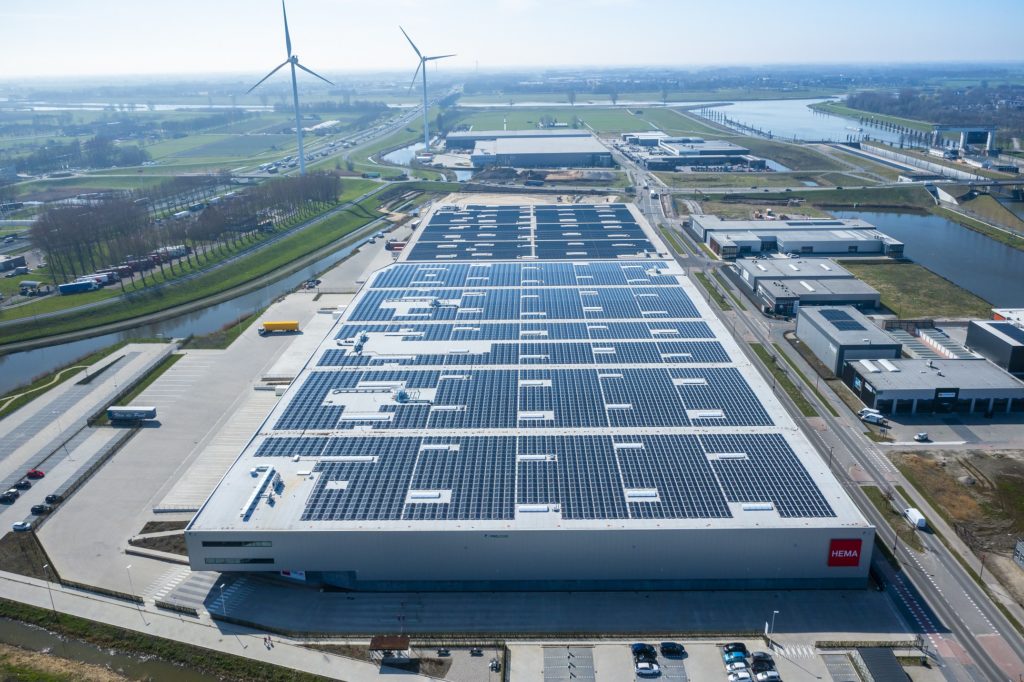
The energy transition makes the production of more solar energy and the introduction of sustainable mobility inevitable, but it is not yet so easy for the users of buildings to find the right balance between supply and demand. Prologis and Sunrock are trying out innovative energy solutions. In the development of DC 5 in Tilburg, they opted for a special experiment: storage of solar power in a huge battery.

For Sander Breugelmans, Regional Head of Europe at Prologis, the pursuit of sustainable logistics property is a logical choice. “As the largest developer and owner of logistics property in the Netherlands, we expressly take our responsibility; Prologis wants to be a good citizen. In our investments, we opt for circular buildings, the enhancement of biodiversity in the vicinity of our buildings and renewable energy. Distribution centres have large roofs; they are ideally suited to the installation of solar panels. He does have one comment, however. “Sometimes such an operation is too complex. Older buildings don’t always have the right construction, but we still manage to generate more energy every year through new construction and modification of existing roofs, such as covering buildings.”
Smart solutions
When it comes to sun as a source of energy, Prologis works closely with Sunrock, a young, fast-growing company that provides smart energy solutions with solar parks on logistics and commercial properties. “At our start, we focused on the large real estate parties and on understanding their demand. We are very transparent about the costs and revenues involved in developing and managing such an energy plant. Sunrock has now built up a portfolio of 1.4 gigawatt-peak projects. This makes us the market leader when it comes to covering large roofs with solar panels and realising energy solutions. Not all of those projects will come to fruition; not all roofs are suitable for the installation of solar panels,” says Maurits van Oranje.
He cherishes the collaboration with Prologis. “In 2016, our company then consisted of only five or six people, we won a tender from Prologis for two roofs, among which was the roof of Cool Blue’s distribution centre. A much broader collaboration has resulted from that. Three years ago, we applied for subsidies for all their roofs, with the intention of developing solar parks together. That is working out well. Our teams are professional, highly motivated and have a click with each other. And we do what we promised back then: to unburden our partner in the field of renewable energy. Sander Breugelmans points to a second challenge. “Our buildings are leased. We want to motivate our tenants to make use of the available energy. We can’t tell that story alone. It is technically complicated. That’s why it’s important to work with a party like Sunrock to be able to have the conversation with our tenants.”
Battery technology
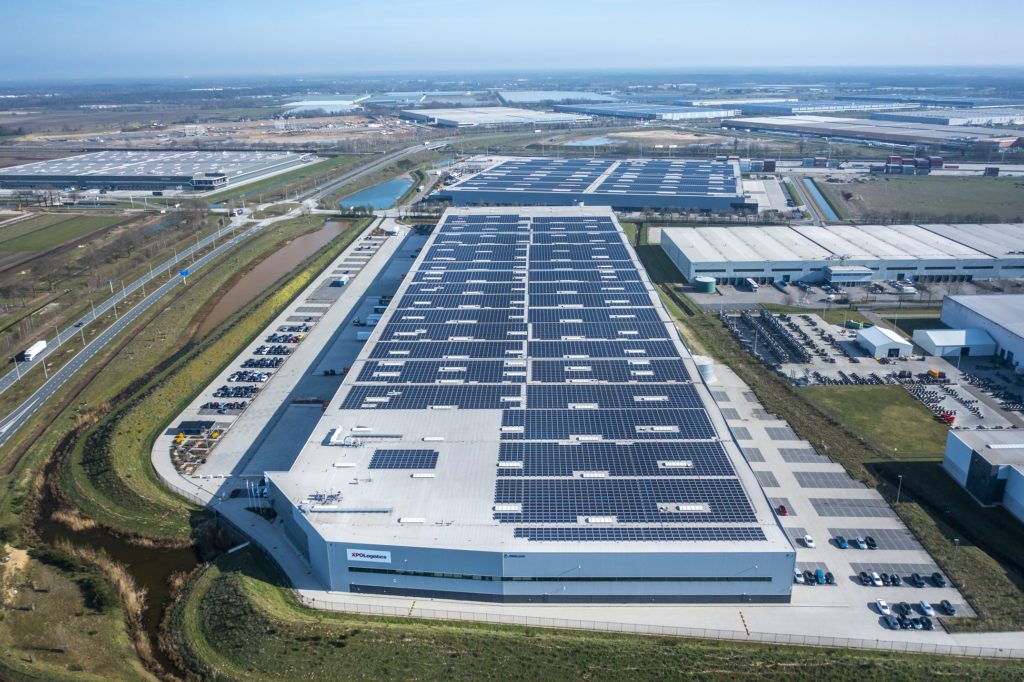
At the Prologis complex DC 5 in Tilburg – a total complex of 70,000 m2 – four megawatts of solar energy are being generated. Sunrock and Prologis have taken an extra step there: energy that cannot be used immediately is stored in a battery the size of a sea container. “Our energy networks are designed to provide households and businesses with power on a very small scale from large power plants. One-way traffic. The system is not built for the supply of energy back to the grid. In many places in the Netherlands, supplying energy back has become a complex matter. We can therefore produce solar, but will have to think up smart, very innovative solutions. That is why we like to talk about smart energy. Think of the creation of an energy hub, a place from which we supply energy to companies in the neighbourhood. Or think of new forms of storage. This is experimental, but we have found each other in a trial with battery technology in Tilburg. We know it has to be done. And it has to happen fast, because extra solar production is necessary to meet our climate targets in our country in ten to thirty years’ time,’ Van Oranje explains.
Breugelmans fully supports this solution. “The energy generated during the day can be used in the evening and at night to charge vehicles or provide energy for third parties. That’s great, but the meaning is broader. It is important to try out new solutions. That produces data that we can learn from. Besides, the energy transition is accelerating. Mobility is going to change. Many trucks and delivery vans are still running on diesel, but this is where a huge change is going to take place. In the vicinity of large cities, we are already seeing a demand for charging facilities. This transition will continue. So it is important to start thinking now about the charging infrastructure we will have to offer in the future.
Sensible strategy
According to Breugelmans, this is part of a sensible real estate strategy. “We develop for the long term; we keep all those buildings in our own portfolio. They must also meet market demand in ten or fifteen years’ time. And then we have to experiment, we have to be prepared to make costly investments. Otherwise, we will not be ready for the future.
Is there a dream perspective? “Ultimately, we must be able to guarantee to fleet owners that power will always be available. Then we can help full throttle replace those diesel trucks with electric transport. Society cannot wait,” says Van Oranje.
Prologis & Sunrock
Prologis is the largest provider of modern logistics property in the Netherlands. The portfolio is approaching 2.5 million m2 of distribution facilities. The offer concentrates in the south of our country and around Rotterdam, Utrecht and Amsterdam. Sander Breugelmans is responsible for the North European activities of Prologis. Sunrock develops, realises, finances and manages large-scale solar parks on roofs of logistics and commercial real estate and expands these solar parks with storage systems and energy efficiency products and services. Maurits van Oranje is a member of the board of directors and CCO. Since last year, Sunrock has been part of the Cofra group of companies.This article was sponsored by Prologis.
In the coming months, we will talk to sustainable business leaders about the opportunities and challenges of the future economy. This time: Johannes Duijzer, CEO of solar energy company Sunrock, about the energy transition. “The real questions are: how do we get it done operationally? And where do we get the stuff?”
What is Sunrock doing to achieve the Paris climate goals?
“Everything we do contributes to the Paris climate goals. Our right to exist is in a society that runs on clean energy. That is what we are working towards. We want to use as many roofs as possible to generate solar energy. We saw that in the Netherlands not enough solar panels were being installed on the roofs of business premises, despite the subsidies. So we started focusing on that.
“We provide the energy solution that suits the property owner. For some, that stops with the rental of the roof. Others want to use the energy themselves. We see that more and more property owners want to benefit from the solar energy they generate themselves. That is more sustainable, because it is locally generated energy. It is also financially attractive. Last year, we regularly had to deal with negative energy prices because of COVID-19. But in the past four months, we have seen prices of 80 to 150 euros per megawatt hour. Your own energy is then soon cheaper.”
It also offers a solution to an increasingly acute problem: the shortage on the electricity grid. It’s not just us who can no longer get a connection, but also the building owners themselves. We then use a battery and consumption optimisation to ensure that the smallest possible grid connection suffices. For example, on a Prologis property we can install twice as many solar panels on a standard connection, thanks to a large battery combined with a fast charging system for trucks.”
What contribution will you make to the future economy in the coming years?
“By the end of this year, we will have 230 megawatts of solar panels operational across 120 locations. We are building very hard. Sunrock has 35 to 45 percent of the market for large-scale roof systems. In the Netherlands we want to grow to 600 megawatts. That sounds easy but it isn’t.
A very important element is the suitability of the roofs. We have now contracted 400 megawatts, of which 230 megawatts will be operational by the end of this year. The potential is almost double that. So half of it will not be installed because the roof is not sturdy enough, the insulation is unsuitable for solar panels or the grid connection is inadequate.
We are growing in all directions with our solutions: on large roofs with off-grid possibilities, such as at Prologis, and we also see many opportunities in the smaller market. In addition, we are expanding internationally and the offering is becoming smarter and more complex. The aim is to have 1.5 gigawatts operational within five years. That’s a big ambition, because it’s becoming more difficult due to the restrictions. At the same time, the dominant political and economic movement is also becoming stricter and clearer. After all, sustainable power must and will happen.”
What are the biggest challenges for the sector in the coming years?
“The biggest challenge is the availability of actually everything. Of all the materials, solar panels, inverters, technical staff. The task is so gigantic. People often do not understand that yet. But if we really want to become sustainable at the pace required to achieve our goals in 2030, that means a huge amount of material and work. The real questions are: how do we get it done operationally? And where do we get the stuff?
In the short term, there is no easy solution to this. As Europe, we have banished the entire solar panel industry to China. You can’t get that back just like that. As a result, we are now very dependent. We are seeing the first companies that are going to supply from Europe. They are still far too expensive. But in time, I do not exclude anything.
There is also a positive development. We see that sustainable energy has become mainstream economics. Young talent in particular is finding it increasingly attractive. Three years ago, it was still very experimental to work at Sunrock, but now it’s the future if you want to make a career. If you want to do the right things and learn relevant things for the next 30 years, this is a very interesting company.”