Amsterdam, 16 August 2025 – Is the solar energy sector taking sufficient responsibility for human rights and environmental impact in its supply chain? Manuella Appiah, ESG Manager at Sunrock: “Doing nothing isn’t an option; progress is made in small steps.”
How is Sunrock doing?
Martin Sanchez Locreille, Marketer at Sunrock: “Since our founding in 2012, we’ve quickly become the market leader in the Netherlands for the development of solar rooftop systems, particularly for logistics and industrial companies. We’re also servicing these customers abroad. We’ve now established a strong presence in Germany and are also growing rapidly in France.”
How seriously does Sunrock take ESG—the impact on the environment, people and society, and good governance?
“The focus is no longer just on generating solar power on rooftops. We offer integrated solutions; for example, with batteries, vehicle charging infrastructure, and smart energy management controls. This means more technology and components in the chain. If you truly want to make a positive impact, you also have to take broader responsibility – for example, in the areas of human rights and the environment.”
How does Sunrock do that?
Appiah: “It’s not just about what you do, but also about how you do it; minimising your negative impact as much as possible. We do this, for example, by carefully considering the parties we collaborate with, the components we purchase, but also by ensuring that the working conditions and salaries of the people who build our systems are adequate.”
Is this common practice in the sector?
What is that?
Karen Vermeer, policy officer at the Social and Economic Council (SER): “In the International Responsible Business Conduct (RBC) Agreement, companies, industry associations, government, unions, and civil society organisations agree to jointly identify, address, and prevent risks of negative human rights and environmental impact in the supply chain. The SER is the independent secretariat of the Agreement.”
What is the approach?
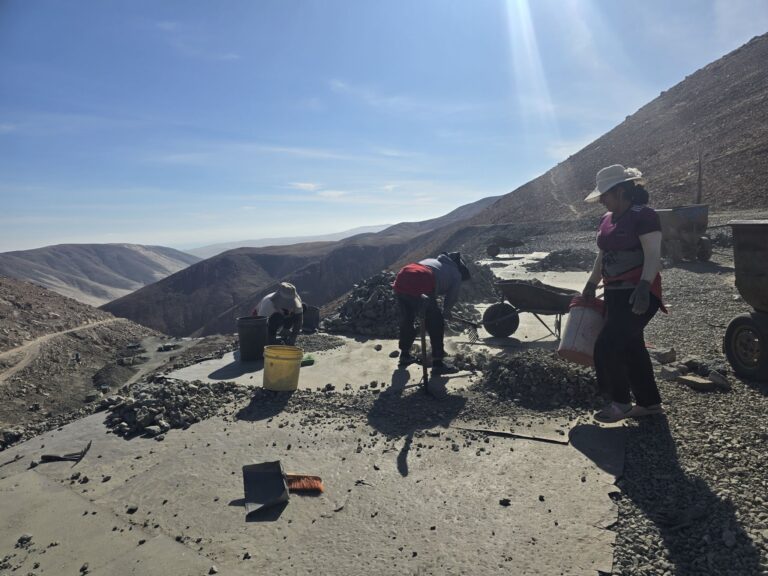
“The focus is on identifying and addressing human rights violations and environmental impact in international production chains, such as the extraction of raw materials for batteries, wind turbines, and solar panels. This is achieved through due diligence by individual companies and through collective action within the sector. To this end, we organise workshops, develop tools, and carry out joint projects. For example, we recently visited copper mines in Peru to identify working conditions and environmental impact, for a project funded by the European Partnership for Responsible Mining (EPRM) and carried out in collaboration with the Danish Institute for Human Rights, The Copper Mark, the Alliance for Responsible Mining, and Sunrock.”
Sunrock already traveled to China last year…
Sanchez Locreille: “That was the first time we actually went abroad as part of our ESG activities. Together with our partners, we visited several suppliers in China to learn more about how PV components are produced and to explore how we can collectively make a greater positive impact.”
Is that having an effect?
Appiah: “We gained important knowledge. The suppliers understand better what we expect from them. This allows them to better meet our expectations. That’s certainly having an effect. We’re very dependent on Chinese suppliers, like the entire solar energy sector. At the same time, we also need to look further into what’s happening in China.”
For example, copper…
“Almost all the products we use contain copper: inverters, solar panels, cables… We’re talking about large quantities. Demand is growing, and there’s no substitute for this material. When it comes to the environment and human rights, it’s crucial to investigate how this material is extracted. Peru is among the top three producers in the world. There’s still a lot of untapped territory; the industry there will only grow.”
What did you find?
Vermeer: “The project’s focus isn’t on large-scale mining, but on artisanal, small-scale mines. However, the people who work there—more than 200,000 nationwide—are dependent on those large companies. They can’t always sell the material they extract directly and can only sell it to those industrial concerns. They often don’t pay enough, leaving the small-scale mines with little money to invest in things like employee safety.”
And the living and working conditions?
Appiah: “The houses are far below par, there’s no electricity or plumbing, and children don’t go to school. The work is dangerous, unhealthy, and hard. For example, the women manually separate the ore. There’s no child labor, as far as we saw. But we did see them playing unsupervised along the deep cliffs of the mines, which was very disturbing.”
And the environmental impact?
Vermeer: “Everyone is responsible for what happens in the renewable energy sector’s supply chains. If we don’t want an impact like this, we all need to take action together. It would therefore be great if more companies joined this project or the Agreement.”
Appiah: “We recently had conversations with several major cable manufacturers. They were only looking into with the origin of the copper they source, and were largely unaware of what’s happening in mines like those in Peru, and in countries like Chile and Congo, where the situation is obviously similar. They indicated they appreciate that end users like Sunrock are asking questions about the origin of raw materials and the associated human rights and environmental conditions. It all starts with a good conversation; that’s the first step.”
You can read the original article (in Dutch) here. Full credits to Solar Magazine.